AI and ML

CVParser Documents

The CV Parser System is an AI-powered solution that automatically extracts important information from PDF resumes. By combining Computer Vision and Natural Language Processing, the system converts unstructured CV data into structured and usable information.

This helps businesses reduce manual work, speed up recruitment, and improve candidate screening accuracy.

Share
Post Thumbnail

INTRODUCTION

Feature Image

Recruitment teams often need to review a large number of CVs to find suitable candidates. This process is usually done manually—reading each CV, extracting key details, and sharing them across teams for evaluation.

Feature Image

However, CVs come in many different formats, making it difficult to process them consistently. Important information such as skills, experience, and education may be presented differently in each document.

Feature Image

To solve this problem, TechTIQ Inc. developed an intelligent CV Parser System that can automatically read, understand, and extract meaningful data from CV files, helping streamline the hiring process.

Our Approaches

There are many tools and libraries available to extract text from PDF files. However, the output is often unstructured and difficult to understand, as the text is only captured line by line without context. For CV parsing, this creates several challenges when trying to extract meaningful and organized information from different document format.

CVs come in many different formats and structures

It is difficult to group related sections correctly

Machines struggle to understand the meaning of the text

A large number of rules are needed to clean and organize the data

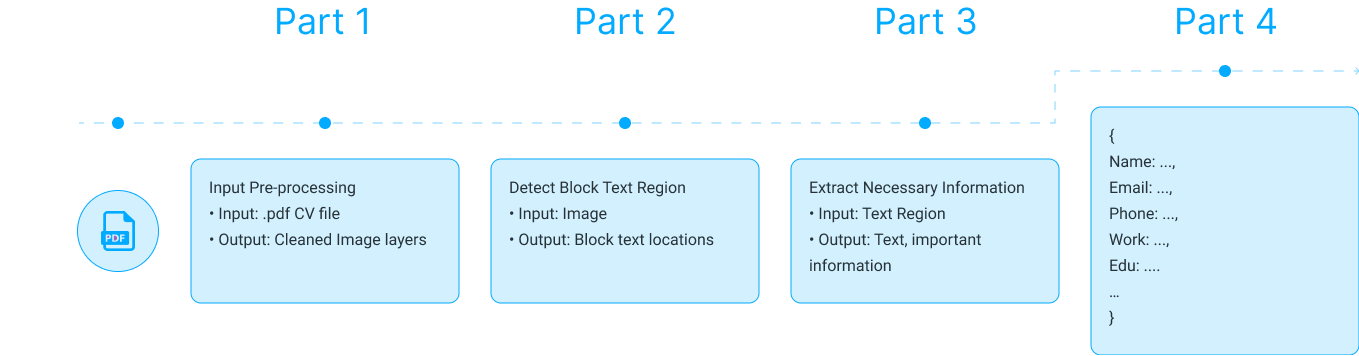
To address these challenges, TechTIQ Inc. developed an end-to-end CV Parser system that can automatically extract meaningful information from PDF files. The solution is designed as a structured process, transforming unorganized data into clear and usable information.

Approaches Image

• In the first step, the system receives the uploaded PDF file, cleans the data, and converts it into image format for further processing.

• In the second step, computer vision and image processing techniques are used to analyze the document structure and identify different sections within the CV.

• In the final step, OCR and Natural Language Processing are applied to extract and understand the text, turning it into meaningful and structured information.

Related Projects

AI and ML
Analyze The Object On Image Using Computer Vision Technologies

Analyze The Object On Image Using Computer Vision Technologies

With the help of Computer Vision techniques, this effort seeks to create a system that can evaluate the Object on Image.
Detail arrow
AI and ML
Natural Language Processing Toolkit

Natural Language Processing Toolkit

The Natural Language Processing Toolkit (NLTK) is a Python-based software application that offers a suite of tools for the purpose of processing natural language data.
Detail arrow
AI and ML
Music Recommendation System

Music Recommendation System

Music Recommendation Systems have become immensely popular, enabling users to explore new songs and artists based on their listening habits and preferences. 
Detail arrow
AI and ML
Product Recognition

Product Recognition

Utilizing AI-based Computer Vision techniques, the Product Recognition system autonomously detects and categorizes products present within images or videos. Through a comprehensive analysis of the visual attributes of products, including their shapes, colors, and textures
Detail arrow
AI and ML
Skin Analyzing System

Skin Analyzing System

A skin analysis system evaluates skin health and appearance using imaging, machine learning, and data analysis to assess conditions like acne, wrinkles, and sun damage.
Detail arrow
AI and ML
Semantic Search For Travel Place Document

Semantic Search For Travel Place Document

This project aims at developing a Semantic Searching Engine that could search with meaning not only to find keywords but to determine the intent and contextual meaning of the input sentence. 
Detail arrow
AI and ML
Optical Character Recognition Document

Optical Character Recognition Document

Every day, a vast quantity of textual information is written or printed on tangible paper, such as study-related messages, invoices, periodicals, books, ads, and so on. Paper contamination is a major issue in the corporate world and has obvious environmental consequences.
Detail arrow

Please install and activate Ninja Forms to display the contact form.

Back2Top